DevMeth
Pre-flight security and production-readiness checks for AI-built apps — scan the code and the live URL, fix with one paste, re-scan until green.
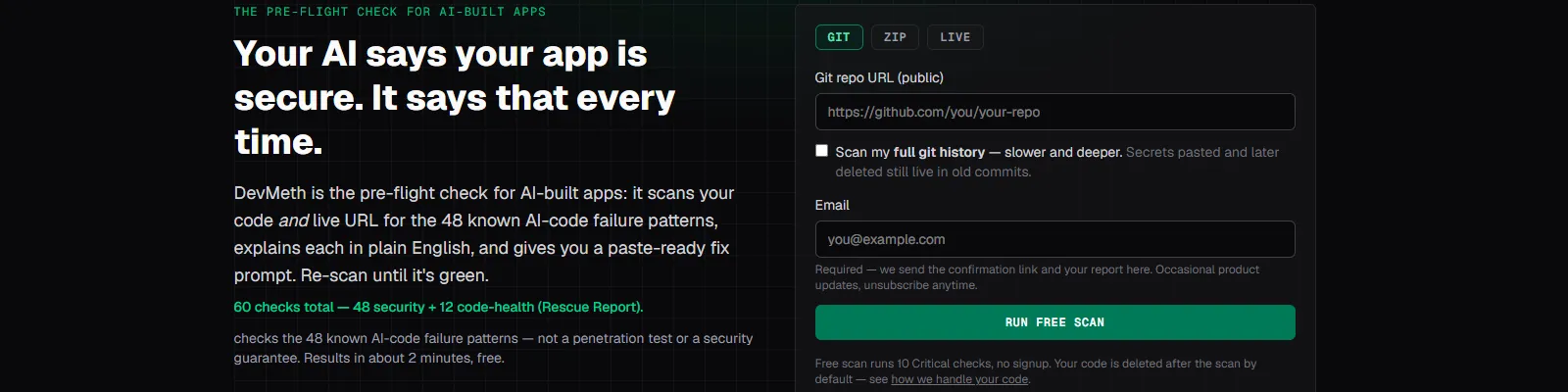
AI writes most new code now — and industry research keeps finding the same thing: it fails the same way every time. Hardcoded API keys, secrets shipped in client bundles, Supabase tables left world-readable, Firebase rules set to true. DevMeth is the pre-flight check for that failure mode: it scans your AI-built app — codebase and live URL — for the known AI-code failure patterns, hands you plain-English findings, and gives you a paste-ready fix prompt for the tool that wrote the bug. Then it re-scans to verify you actually fixed it.
The problem
Nearly every AI-app breach traces to the same few root causes, because the assistants make the same mistakes at scale. The existing tools don’t meet the moment: enterprise SAST speaks CWE jargon and is priced for security teams, manual audits cost hundreds to thousands of pounds, and free scanners check only the live surface — never the code. Meanwhile the developer is left saying “it works… is it safe to launch?”
The insight DevMeth is built on: the failure modes are predictable, predictable failures can be checked automatically, and the fixer is already sitting on the user’s machine — it’s the AI that wrote the bug. Nothing on the market connected the checker to the fixer. DevMeth is that connection.
How it works
A closed loop in four steps:
- Scan — point it at a repo (git clone or zip upload) and the deployed URL. Two minutes.
- Report — plain-English findings with evidence, locations, and severity. Secrets are masked; nothing sensitive is exposed back to you in the report.
- Fix — copy the generated fix prompt and paste it into Cursor, Claude Code, Lovable, or Bolt.
- Verify — re-scan until the finding turns green.
Every check in the catalog ships all three halves: the evidence to trust the finding, the why in plain English, and a fix prompt tuned to the failure — for a hardcoded key, rotate first then remove, because deleting the line doesn’t invalidate the credential.
The two surfaces matter. Static analysis catches what’s in the code; a live prober catches what’s true of the running app — for example, probing whether an anonymous user can read your Supabase tables regardless of what the code intended.
Under the hood
- The catalog is versioned data, not prompts — 48 known AI-code failure patterns plus a readiness series (dead code, swallowed errors, missing route tests, silent drift) live as versioned YAML, compiled into the product. Checks evolve without rewrites.
- Deterministic engines decide, LLMs verbalize — gitleaks-class secret scanning (including git history, not just HEAD), Semgrep, and purpose-built detectors for auth, payments, logging, and routes produce the findings. A small LLM layer handles triage and tone — never verdicts — with response caching, golden-file evals, and a red-team suite.
- Precision over coverage — every check is a finding that is always real. No maybe-findings: a false positive kills trust in a tool like this instantly.
- Built for trust — scanned code is wiped on a retention schedule, evidence is masked, and the “Verified by DevMeth” badge is a deterministic SVG that leaks no finding data — only the date and catalog version.
- Real production plumbing — Next.js 16 front end, a dedicated Node scan worker consuming a pg-boss queue backed by Postgres/Drizzle, Stripe billing, Resend email, PDF report export, and Sentry — with a Playwright e2e suite (including axe-core accessibility checks) and chaos, load, and rollback drills scripted against the queue.
And the proof DevMeth leads with is the product turned on itself: its own repo runs the full catalog, and the verified badge on the DevMeth README was earned by DevMeth scanning DevMeth.