PIE — Property Intelligence Engine
Property research SaaS — full AI investment reports in under a minute.
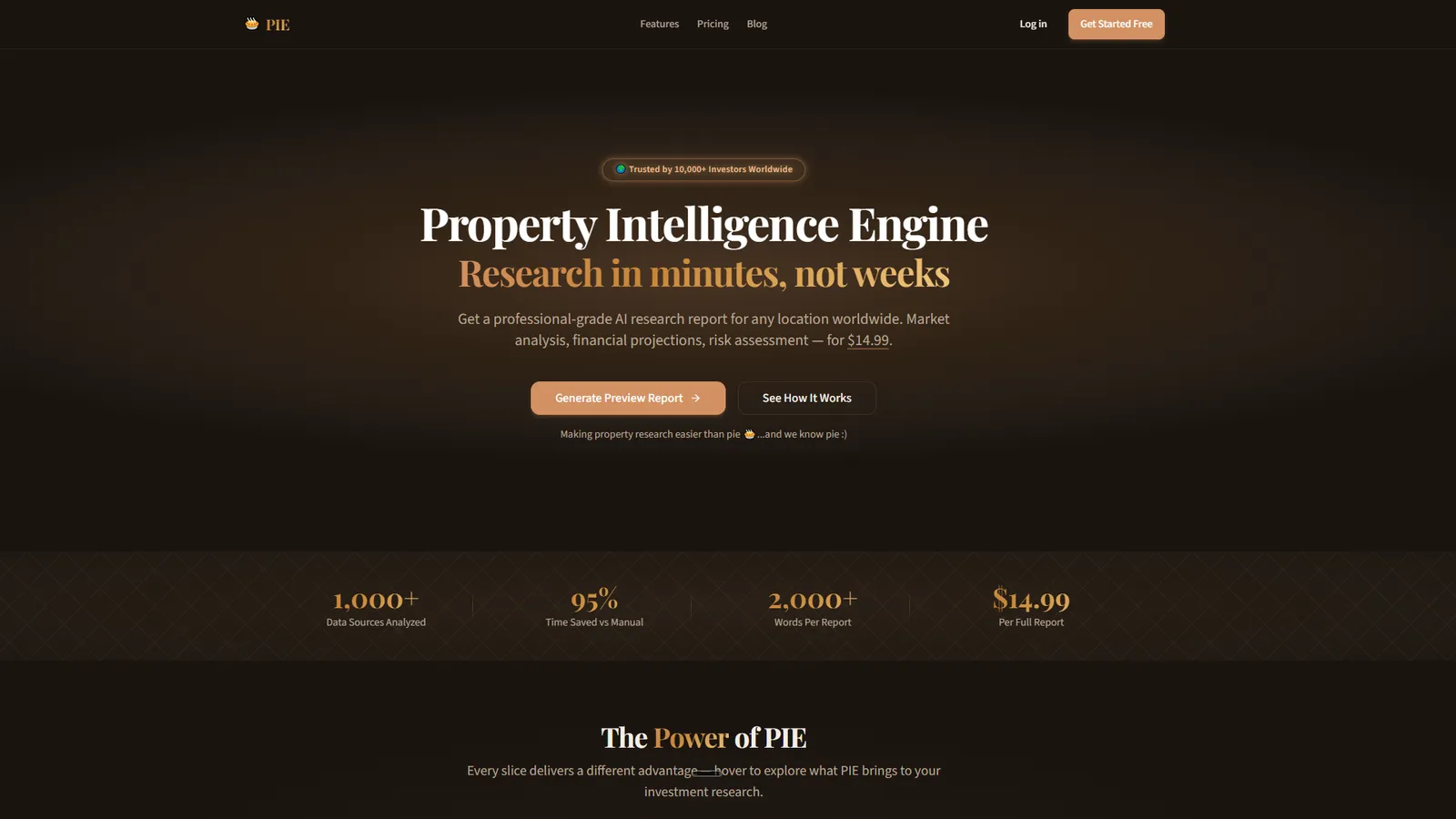
Property research is slow and expensive — a single investment report from a consultancy runs £500–800 and lands weeks later, by which time the deal is often gone. PIE (Property Intelligence Engine) turns that into a product: enter a location, a budget, and your goals, and get a 2,500–3,500-word professional report in under a minute.
The problem
Most of what you pay for in a traditional research report is publicly available data, assembled and interpreted by hand. The value isn’t the data — it’s the synthesis, the structure, the comparison across markets and risk factors. That is precisely the shape of work an AI pipeline does well, provided you build it as discrete, reliable steps rather than one giant prompt and a prayer.
PIE also had to be a business, not a demo. That meant a real purchase flow, a report that feels premium to read, and a content engine that earns organic traffic in a market where every keyword is contested.
How it works
The funnel is deliberately simple. A visitor enters a location, budget, and goals and gets a free ~500-word preview — enough to prove the quality, with the full report gated behind it and an account created along the way. To unlock the rest, they pay once via Stripe Checkout ($14.99 for a single report, or packs of five and ten). The moment payment confirms, a webhook kicks off the full pipeline.
Behind that click, an explicit state machine walks the report through preview → paid → completed. The full prompt fires against Perplexity, the resulting markdown is written to Postgres, a PDF is rendered server-side and stored, and a delivery email goes out via Resend. Each stage is its own API route — generate-preview, generate-report, generate-pdf, stripe-checkout, stripe-webhook — so a failure anywhere retries cleanly without re-charging anyone.
The report itself is meant to be read, not just generated. React-Markdown renders the body with full GFM, Recharts draws the financials, and an interactive map — Leaflet over a custom D3 / TopoJSON projection — grounds the analysis in a real place. The whole thing animates with Framer Motion so it reads like a product, not a document. TanStack Query keeps the dashboard snappy with caching and optimistic updates, and PostHog watches how people actually use it. Behind the marketing sits a content pipeline of its own — a raw idea pool that’s scored and ranked into a publishing calendar, then turned into coordinated blog posts and landing pages.
Under the hood
- Supabase end to end — Auth, Postgres, and Storage, all typed through Drizzle ORM so a schema change can’t silently break a query.
- Stripe one-time payments with a webhook-driven status machine, so payment, generation, and delivery never desync.
- Perplexity (sonar-pro) as the research brain — chosen for grounded, citation-friendly output over raw generation.
- Server-side PDF via Puppeteer, stored in Supabase Storage and linked from the report.
- A real SEO and GEO layer — an MDX blog with answer-first structure, JSON-LD structured data, a generated sitemap, and an
llms.txtoptimised for the LLM crawlers increasingly answering these queries. - Reports you keep — every purchased report is saved to the account, viewable as a live web page and downloadable as a PDF, with packs lowering the per-report price for serious screeners.
- A content engine behind it — idea scoring, research, and a publishing pipeline that turns one brief into a coordinated set of posts and landing pages.
PIE is how I build a monetised AI product around a single, well-scoped pipeline — research as a service, sold one report at a time.