Traffic Driver
Autonomous growth engine monitoring and engaging across 12 platforms.
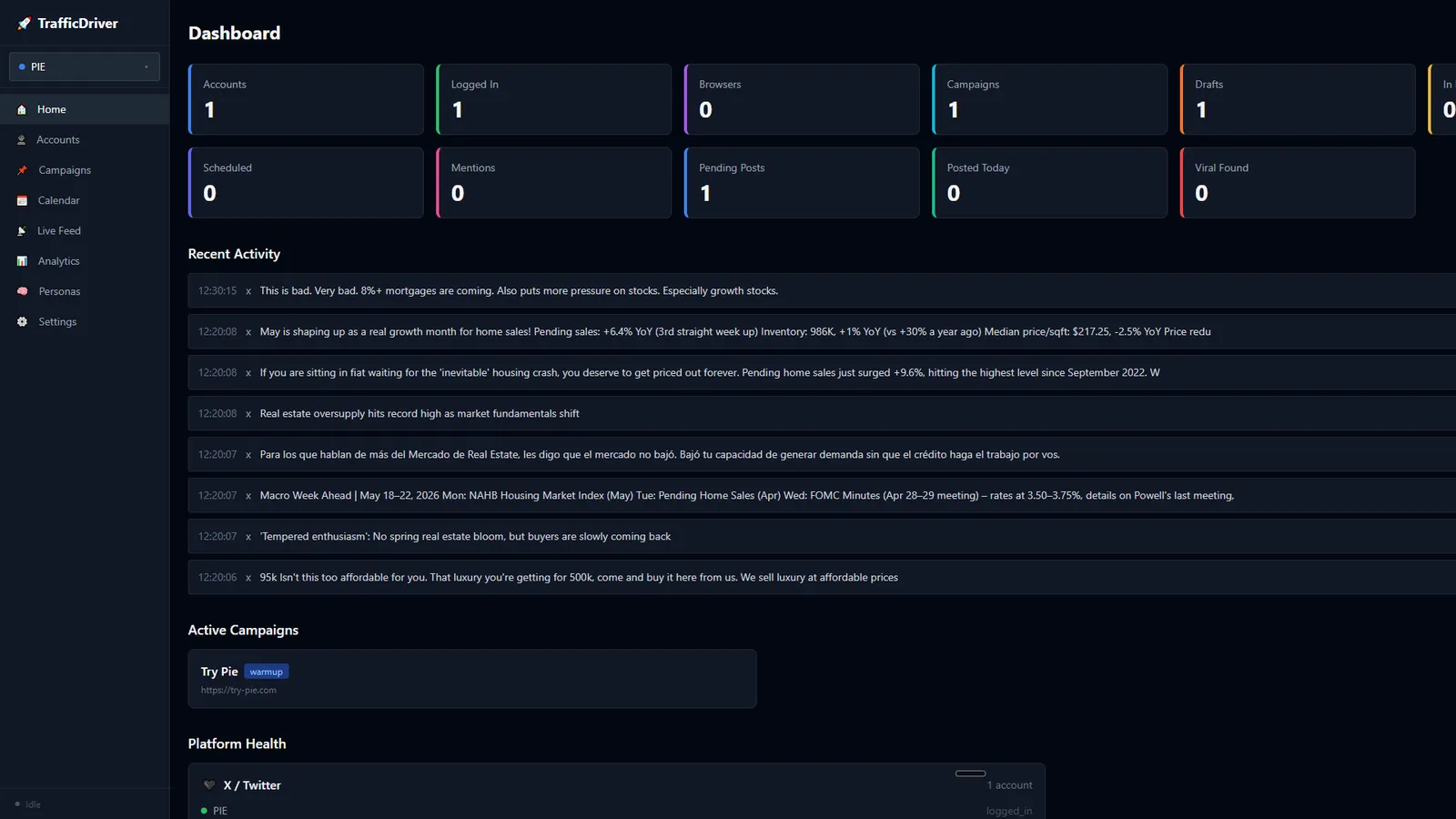
Organic growth across a dozen platforms is a volume-and-judgment problem — exactly the shape of work autonomous agents are good at. Traffic Driver is a self-hosted desktop engine that monitors feeds, scores relevance, drafts responses, and engages across twelve platforms — with a human always able to step in where it matters.
The problem
Showing up on Reddit, Hacker News, Quora, Stack Overflow, and the rest means watching feeds, judging whether a thread is worth entering, and replying well — hundreds of times a week, consistently, across personas. It doesn’t scale by hand, and it shouldn’t. But handing it to a bot naively is how you get an account banned inside a week. The interesting problem is the control system: how to move fast without ever looking like a spammer.
How it works
Two background services run independently. The orchestrator watches the targets you configure, fetches items from each platform, and scores every one for relevance. Items above the threshold get a drafted response; items above fifty percent land in a review queue; the rest are dropped. The poster picks up approved or high-confidence drafts and submits them through real browsers, screenshotting on failure and retrying with backoff.
The confidence gate is the whole point. At or above the auto-post threshold — and only after the compliance layer is satisfied — it posts on its own. Below that, nothing ships without a person approving, editing, or rejecting it. A human is always in the loop where the stakes are real.
Around that core sits campaign management: phases that ramp an account from warmup to authority to traffic, with link ratios that climb from zero to full as trust is earned; personas with their own tone and system prompts; A/B testing on what actually performs; and health monitoring that watches for shadowbans. A content calendar schedules cross-platform distribution chains — one authority post fanning out to the member accounts — and an eight-tab analytics view breaks down performance, sentiment, competitors, and influencers. In a single early cycle the orchestrator surfaced twenty-nine relevant items from three platforms with no human input.
Under the hood
- Twelve platform monitors and twelve posters — Reddit, Quora, Hacker News, Stack Overflow, Dev.to, and Medium over their HTTP APIs; X, LinkedIn, and Facebook through real logged-in browser sessions; YouTube, Product Hunt, and Substack beside them.
- CDP-based browser control via a separate
browser-harnesspackage, with one isolated Chrome profile per account — separate debug ports, PID tracking, and login detection per platform. - A compliance layer that’s non-negotiable — spam detection, quality checks, per-persona daily limits, per-platform rate limiting with Gaussian jitter, and phase-aware caps on how often a link appears.
- GLM via z.ai for relevance scoring, drafting, confidence self-evaluation, and sentiment, with the model auto-selected by task complexity.
- A full intelligence layer — engagement and performance tracking, A/B test winner evaluation, influencer targeting and scoring, competitor monitoring, brand-mention sentiment, and automated weekly and campaign reports.
- A full desktop app — FastAPI backend, SQLite, a React + Tailwind dashboard, an Electron shell, and live updates fanned out over WebSocket so the dashboard reflects what the agents are doing in real time.
- A durable activity log — every discovery, draft, post, and review is written to SQLite with its confidence, engagement, and A/B metadata, so nothing is lost on a restart and everything is auditable after the fact.
Traffic Driver is what an agentic system looks like when it has to survive contact with the real, messy web.